
Student research · Texas A&M University–San Antonio
Chemistry or
rotation size?
Auditing pair-level familiarity metrics in the NBA. I built MWDT (Minutes Weighted Dyadic Tenure) to measure how much time specific teammates spend on the floor together, then tested what it really captures.
Submitted to MIT Sloan SSAC 2027
Supervised by Dr. Tan Kim, Department of Management
The question
Teams talk about chemistry, and lineup data make it easy to turn shared minutes into a chemistry number. Research suggests familiarity lives between specific people, not across a whole roster. So I measured it pair by pair, across all 30 NBA teams from 2022–23 to 2024–25, and asked what such a metric actually measures.
Key findings
MWDT tracks team Net Rating closely: one standard deviation goes with about +2 points per 100 possessions.
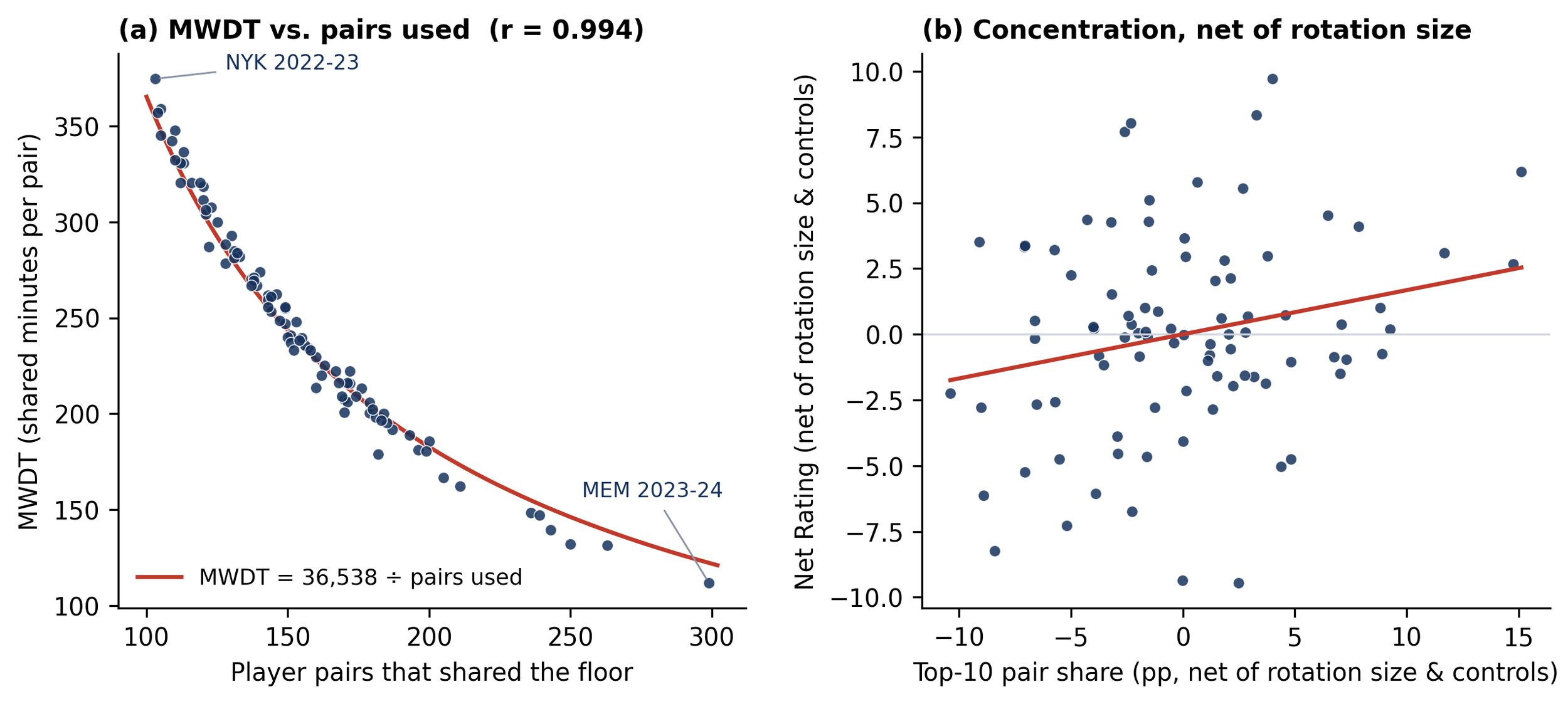
But every minute puts exactly 10 pairs on the floor, so MWDT mostly counts how few player pairs a team used: its rotation size. Once rotation size is controlled, MWDT adds nothing.
Among teams with similar rotations, running more minutes through the 10 most-used pairs looked helpful (Net Rating per SD). This result is exploratory, not established.
Why it matters
Any chemistry or continuity metric built from shared minutes should be checked against rotation size before it informs roster decisions. All data, code and results are open and reproducible on GitHub.
Spring 2026